Wednesday, 26 August 2015

Wildlife Watch: Ragwort

Ragwort.

There's a strange love-hate relationship with this biennial plant in the countryside. There are nineteen species to be found in the countryside and although this includes the likes of Oxford ragwort, brought here by the Victorians, you will most likely encounter Common ragwort. A native plant but one that is very much treated like a foreign invader with much time invested in removing it. The reason? Well it's pretty toxic, particularly to horses and cattle. This isn't much of an issue when it's alive as it has a bitter taste and grazers are unlikely to eat it unless the whole field is jaundiced with the plant or overgrazed. But when a field is cut for hay ragwort loses its bitterness whilst retaining its poisonous qualities.
Interestingly, a green dye can be made from its leaves and a yellow one from it's flowers.

However it is also quite an important plant from a wildlife point of view. It provides a habitat and food for at least 77 species of insect, 30 of which use ragwort exclusively, and it is a significant food source for 22 of the remainder. This includes some scarce species such as the Sussex emerald moth and Picture-winged fly but one of the best known is the Cinnabar moth.

This is a striking black and red day-flying moth. With red lines running along the outside its black forewings each splodged with two heavy red spots; its scarlet underwings peek though underneath. It's one of the most colourful moths we have in the UK and often mistaken as a butterfly as a result. Its caterpillars are equally distinctive, wasp-like with yellow and black stripes to warn predators of their poisonous nature (they absorb toxins from the plant)

Although it also uses the plant Groundsel as a foodplant for its caterpillars, ragwort is significant in it's survival as it provides toxins to make the caterpillar and moth unpalatable and is also a much larger plant for caterpillars to feed on, meaning more caterpillars survive.

Studies looking at Cinnabar moths have shown population declines due to the persecution of its foodplant ragwort so it may appear strange that many conservation organisation tasks are focused on removing what is a native and ecologically important plant.

Well it's largely so a hay crop can be taken. This is a way of managing levels of nutrients of grasslands. The hay itself can then either be used to provide food for a countryside organisation's livestock (as grazing is used to manage grasslands as well) or to sell to make some money. Ragwort can also be an issue if it takes over an area as it is a quick coloniser of bare ground and can take over and dominate some fields, this is more of an issue if next to other people's hay meadows as the seeds are wind dispersed.

Outside of these circumstances though I believe we should live and let live and leave ragwort and the insects that depend on it to get along with things out in the rest of the countryside. Sure, control ragwort where it's likely to be an issue but not look to eradicate it.

Saturday, 8 August 2015

Lawn bioblitz & Wildlife Watch: The teasel

So this is the second year of a section of our lawn being under a hay-cut (however much my dad grumbles about it) so it's time to go out for another bioblitz and see what's there. It's a little later in the year than the one I carried out last year and most plants are in a post-flowering stage so I may have missed a few (last year's survey was in June as opposed to August).

Last year's count was 24 species of plant which you can find HERE.


This year's list:

1) Cat's ear
2) Dandelion
3) Smooth hawks beard
4) Spear Thistle
5) Meadow bent
6) Rye grass
7) St John's Wort
8) Ground ivy
9) Red clover
10) Wild strawberry
11) Creeping buttercup
12) Ribwort plantain
13) Cow parsley
14) Hop trefoil
15) Teasel
16) Wood avens
17) Daisy
18) Primrose
19) Cowslip
20) Unknown grass similar to wheat

The list looks very different this year owing to it being later in the year with many of last year's species not being recorded at all. Four less species were recorded which may seem like a decrease in biodiversity but is due to the survey taking place later in the year when fewer species are flowering and hence not visible. It was good to see a cowslip flowering on the bank earlier in the year and there are a couple of other species present that weren't spotted last year, notably Teasel which is a large flowering plant that I'm going to look at for the Wildlife Watch - of which there will be two this month as I missed July's. I will aim to carry out next year's count a little earlier in the season as I know I've missed a few species such as the buttercups this year.


Wildlife Watch
The Teasel (Dipsacus fullonum)

The teasel is a striking architectural-looking plant, growing up to 2 metres, with a prickly stem and unusual spiny cone-shaped flowerhead containing small lilac flowers arranged in a ring. These florets appear as two bands in the centre of the cone and migrate outwards towards the edges during the July-August flowering season.

It's leaves too are strange. Arranged opposite one another they form a 'cup' at their bases and often collect water. These pools of water help prevent sap-sucking insects from climbing the stems. Studies of teasels have also shown that they are partially carnivorous, absorbing nutrients from insects that have drowned in these leaf-pools leading to greater seed production. The teasel is a biennial and only becomes a tall plant in its second year. It spends its first as a basal rosette close to the ground distinguishable by short curved spines on it's bumpy leaves. 

It has wildlife value as a nectar source for insects such as bumblebees and butterflies in the summer and the seeds provide an important food source for goldfinches in the autumn and winter months. The name derives from its use to 'tease' cloth as it was used to full in cloth production. 

Sunday, 26 July 2015

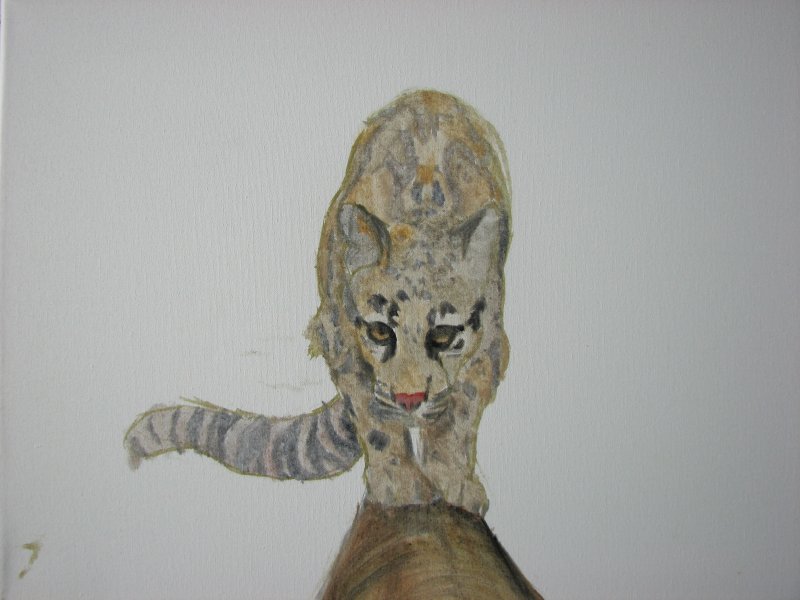
Wildlife painting part 2

Here's is the second part of the progress of my clouded leopard painting.

So this is where we left off from last time:

As you can see the leopard itself was largely incomplete.
As I began to texture the legs and face I realised that I had skewed the image somewhat and the ear on the right side needed correcting along with the slight lean visible in the back. Sometimes these things happen with paintings and you need to tweak them into shape. I also added some dark textures into the branch the leopard was walking along.
Having adjusted the issues I found I added some more texturing to the branch as well as putting in some more foliage into the painting along with the whiskers.
Finally I added some more toning to the leaves and branch and gave more definition to the raised paw and lightened the face a little. Hope it's done now, just need to think of a title :)


Sunday, 12 July 2015

Pet Breed Focus: The Leonberger

Whilst at the Dog Fun Day to handover my donated painting I saw various breeds of dogs from whippets and border collies, to Bernese Mountain dogs and lurchers. But by far the largest were a couple of Leonbergers - one still technically a pup. So that's the breed I'm going to take a look at:

Their name comes from the city of Leonberg in Germany where the breed is said to have been developed. The town has a lion as its crest and the Leonberger was bred in part to resemble a lion in stature.

They are a very large muscular breed with long rough double-coat of tawny fur and a black mask on face. They have a long relaxed tail and feathering of fur on the backs of legs and need a lot of brushing. Gender difference is particularly notable with males being far more muscular than females sometimes with  obvious 'mane'. The average height is around 70-75cm at withers (top of shoulders) and they weigh in at 50-65kg on average. long relaxed tail. feathering of fur at back of legs. They have a relaxed and self-assured temperament but socialisation is very important for good behaviour as the dog is so large you don't want it to become difficult to control. 

They are generally a healthy breed but have some health risks that come with larger breeds of dog such as bloat so should be fed 2 smaller meals in the day rather than a single large meal. Hip dysplasia is a problem for many large breeds but is largely controlled in Leonbergers. Lifespan, however, averages at just 7 years, this is not unusual for large dogs but is much less that the average breed of pedegree dog.

The breed is claimed to have been developed in 1830 by Heinrick Essig, mayor of Leonberg using a Newfoundland and and early St Bernard. later adding a Pyrenese mountain dog although this is somewhat disputed. Regardless the first registered dogs were in 1846 and become popular in European royal households. Traditionally the breed was also used as a farm dog for keeping watch as well as for draft work and later as a working dog used for search and rescue.

The modern breed saw the addition of more Newfoundland as the breed was devastated by the First World War with reportedly only 5 surviving. After some recovery it was again used in the Second World War to pull ammunition carts and was again dramatically reduced to just 8 individuals. The dark mask of the modern breed only came to be in the modern breed.

Friday, 3 July 2015

Summer Exhibition in Canterbury

I'm taking part in the East Kent Art Society Summer Exhibition this year in Canterbury. The exhibition starts today (Friday 3rd of July) and runs through to Sunday 12th at the newly refurbished Westgate Hall in Canterbury.

I am exhibiting and hoping to sell these two pieces of artwork and shall be helping to steward the exhibition on Tuesday 7th between 10am-1pm.
Red Panda
In a Melting World

It was looking pretty good when I am came in to drop my paintings off on Thursday and they were beginning to set things up, so is definitely worth taking a look around!

Thursday, 25 June 2015

New Wildlife Painting..

Following my trip to the local zoo a few weeks ago I've started a new painting. It's still very much not done but here are the first few early stages of it.

Points if you can tell me what animal it's going to be ;)


Wednesday, 10 June 2015

Wildlife Watch: Adonis Blue

For June I'm looking at the Adonis Blue butterfly, so named after its beautiful bright blue wings. This is a butterfly that's found on warm dry calcareous grassland (chalk or limestone) and as such it is restricted to the south of England in the UK. In the past numbers have declined rapidly thanks to the intensification of farming but it has since seen some recent recovery. It's also the symbol of the Kent Wildlife Trust.


Adult males have bright sapphire wings on their uppersides and can be distinguished from other blue butterflies by this as well as the presence of dark lines that cross into the wings' white borders. This 'checkering' is also present on the female Adonis blue but she has dark chocolate-coloured wings instead with some orange spots along the edge. This is very similar to another butterfly, the female Chalkhill blue but the Adonis blue female can be distinguished by the presence of blue scales by the orange spots on the hindwing which are white in the Chalkhill. On the underside, like most blue butterflies, the wings are a warm grey/brown with black spots ringed in white with rows of orange spots near the wing edge.
(Left) Female Adonis blue                 (Right) Side view of a male on marjoram
This butterfly needs a short sward (grass height) of ideally 1-4cm to flourish. This is because it creates a warm microclimate for caterpillars to develop. Caterpillars are green and hairy with two central yellow broken lines running down their back and two thin yellow lateral stripes. They have only one food plant - Horseshoe vetch.
Caterpillar on Horseshoe vetch
Adults feed on nectar from flowers such as wild marjoram and ragwort, and males may also be found in groups on animal dung extracting nutrients. As such it needs a diverse grassland habitat that is grazed at least some of the year and favours south-facing slopes.

There are two generations every year with the first emerging around May and a second in August. They are roughly on the wing for a month where they mate and lay eggs, singly, on horseshoe vetch. Like other blue butterflies the Adonis blue has an interesting symbiotic relationship with ants. Caterpillars produce a sweet secretion from a gland which ants are fond of. In return the ants will protect the caterpillars and later the pupae from predation, even creching them together and burying them at night in a small underground cell to protect them. After overwintering as a caterpillar, often in ants' nests the Adonis blue will be ready for metamorphosis the following year.